Making the Shift from Pagers to Secure Messaging to Improve Clinical Communications and Collaboration
Topic : management consulting | professional coaching
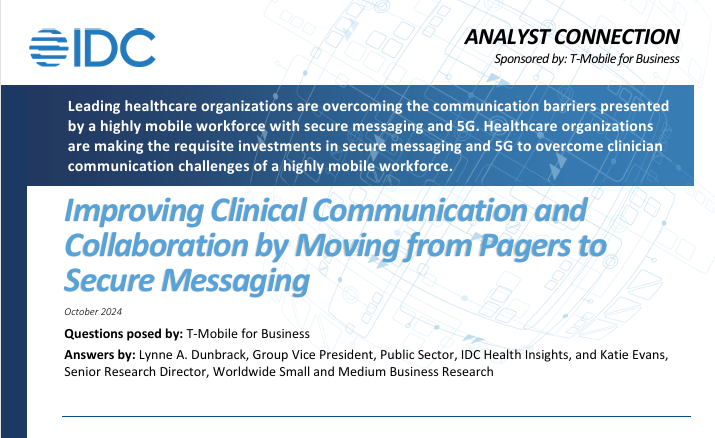
This analyst brief explains why healthcare organizations are replacing outdated pagers with secure messaging and 5G-enabled clinical communication tools. As clinicians become increasingly mobile and care environments more complex, modern communication solutions help eliminate delays, reduce errors, and improve coordination across care teams and facilities.
- Why organizations are shifting from pagers: Legacy paging systems slow down workflows, frustrate clinicians, and often lack the encryption required by HIPAA. Secure messaging consolidates communication into fewer devices, lowers costs, and improves care team coordination.
- How secure messaging improves care: Encrypted, real-time communication enhances patient safety by reducing miscommunication—one of the leading causes of sentinel and “never events.” It also improves clinician efficiency and patient satisfaction, both of which carry financial implications for hospitals evaluated through HCAHPS scores.
- Common use cases: Care team updates, STAT alerts, image sharing, surgical readiness notifications, care coordination with home health teams, and communication with patients and family caregivers. Integrations with clinical systems make these tools even more powerful.
- Selecting the right solution: Healthcare organizations must decide between basic secure texting tools and full clinical communication and collaboration platforms that integrate voice, data, mobile apps, VoIP, and Wi-Fi/cellular connectivity. Reliability, security, scalability, and flexible connectivity are key selection criteria.
- The role of 5G: Rather than futuristic applications, today’s 5G value lies in stronger, faster, more reliable communication inside and outside facilities. Its high bandwidth and low latency support mobile clinicians, enable consistent access to patient data, and ensure dependable communication across all care environments.
As healthcare providers modernize communications, partners like T-Mobile for Business offer the 5G connectivity required to support secure messaging, mobile care teams, and the next wave of digital health innovation.
Want to learn more?
Submit the form below to Access the Resource